Gurdwara Nankana Sahib is the most sacred site as the birthplace of Guru Nanak Dev Ji (1469), the founder of the Sikh faith. The gurdwara complex marks the village of Rai Bhoi Ki Talwandi—later renamed Nankana Sahib—where Guru Nanak’s life, teachings, and spiritual vision originated, making it the foundational locus of Sikh sacred geography. The significance of Gurdwara Nankana Sahib lies in its embodiment of the core principles articulated by Guru Nanak Dev Ji: belief in one formless Divine (Ik Onkar), rejection of caste and religious exclusivism, emphasis on Meditation (Naam Simran) , honest labor (kirat karni), sharing (vand chakna), and service (seva). As the place of the Guru’s birth, the site symbolizes the emergence of a universalist spiritual message that challenged entrenched social hierarchies and ritual formalism in late medieval South Asia. Beyond its theological importance, Nankana Sahib occupies a central role in Sikh collective memory and identity, functioning as a major pilgrimage center and a symbol of Sikh continuity across political borders. It anchors Sikh history in western Punjab and affirms that Sikhism’s origins are inseparable from the cultural and social landscape of the region, making the gurdwara not merely a commemorative shrine but the spiritual point of origin of the Sikh tradition itself.
Gurdwara Nankana Sahib in Nankana Sahib, Punjab, Pakistan is one of the holiest and most important pilgrimage destinations for Sikhs around the world. It stands at the spot where Guru Nanak Dev, the founder of Sikhism, was born in 1469, and the site has drawn devotees for centuries to honor his life, teachings, and legacy.
For travelers seeking a spiritually rich and historically deep Sikh pilgrimage, Nankana Sahib offers an immersive experience that blends sacred heritage, devotional practice, and meaningful reflection.
A Sacred Birthplace
Gurdwara Nankana Sahib — often called Gurdwara Janam Asthan — commemorates the very house and surroundings where Guru Nanak Dev Ji first saw the world. Its name literally means “the place of birth,” and the shrine is regarded as the most central historic site in Sikhism because all Sikh lineage traces back to the teachings that began here.
Across generations, pilgrims have traveled from around the globe to visit this shrine, especially during Guru Nanak Gurpurab — the birth anniversary celebrated with great devotion every October–November.
Deep History and Legacy
The earliest structures marking Guru Nanak’s birthplace were erected soon after his life, and the modern gurdwara complex has developed over centuries. The current Janam Asthan shrine was formalized in the late 16th century, with significant patronage and renovation over time, including contributions during the Sikh Empire era.
The complex has witnessed pivotal historical moments, including the Saka Nankana Sahib in February 1921, when peaceful Sikh reformers were tragically killed while advocating community control of the gurdwara. This event became a defining milestone in the Gurdwara Reform Movement.
Beyond being a birth site, Nankana Sahib represents resilience, spiritual awakening, and the enduring commitment of Sikhs to uphold truth and unity.
Spiritual Significance
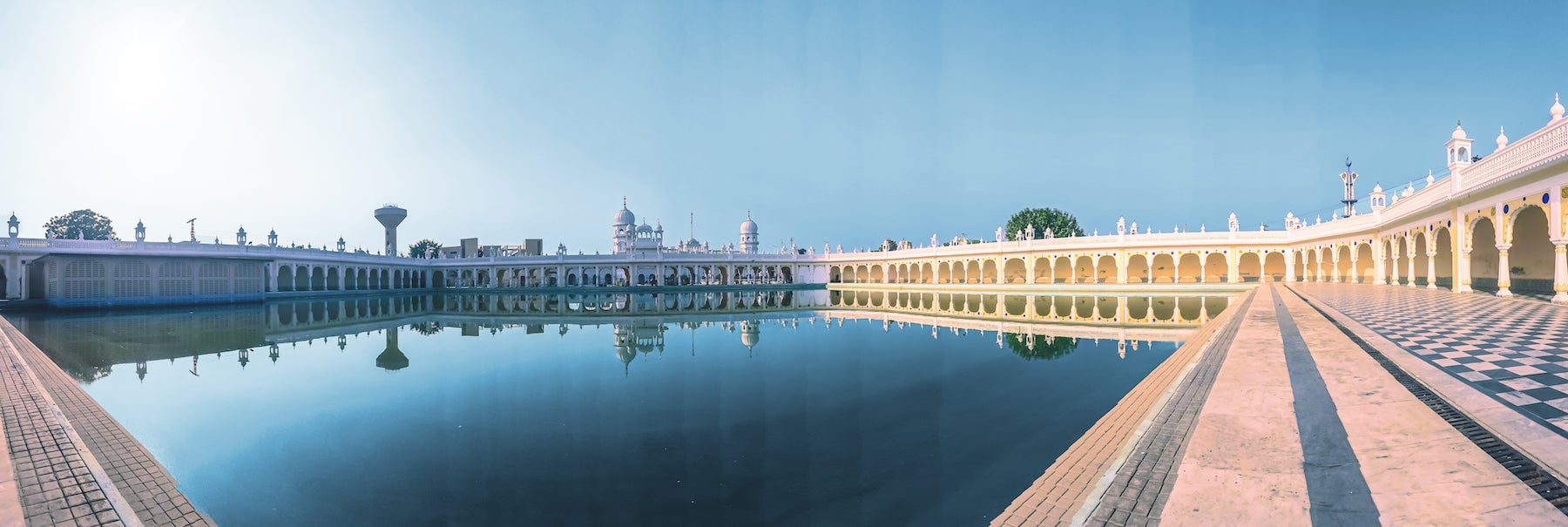
Visiting Gurdwara Nankana Sahib offers more than a historical stop — it is a place for profound spiritual reflection. Pilgrims come to pay homage to Guru Nanak Dev Ji, participate in kirtan (devotional hymns) and langar (community meals), and reflect on the core Sikh teachings of Ik Onkar (one God), equality, service, and compassion. Every part of the complex, from the main sanctum to the langar hall and the Saroor Sahib (holy water pool), reinforces a sense of sacred history and communal harmony, connecting visitors to centuries of devotional practice at the birthplace shrine.
Architecture and Layout
The Nankana Sahib complex blends traditional Sikh architecture with functional spaces for community gathering and contemplation. The Darbar Sahib, the main prayer hall, features a large dome and open courtyard, while the langar hall serves free meals to pilgrims of all backgrounds. Residential accommodations support visiting yatrees, and the holy pool (Saroor Sahib) allows for ceremonial cleansing and ritual reflection. Decorative stained glass, marble flooring, and symbolic religious art enrich the spiritual ambiance, while expansive open areas accommodate festivals and major celebrations, making the site both visually impressive and spiritually resonant.
Location & Accessibility
Situated in Nankana Sahib, Punjab, Pakistan, the shrine lies approximately 75 km west of Lahore along well-connected highways. Improved road access and immigration facilities support pilgrimage tourism, and the site also serves as a gateway to related shrines in the region, including Gurdwara Bal Lila, Gurdwara Patti Sahib, Gurdwara Malji Sahib, and Gurdwara Kiara Sahib. During peak pilgrimage times such as Vaisakhi or Guru Nanak Gurpurab, thousands gather to celebrate in devotion and community.
Experience on a Sikh Pilgrimage
A curated pilgrimage to Nankana Sahib allows the shrine to serve as a spiritual centerpiece. Private guided tours provide deep historical and cultural interpretation, while seamless transportation and logistics from Lahore and surrounding regions ensure ease of travel. Visitors enjoy priority access to religious services and festival events, high-comfort accommodations, and tailored timing to avoid crowds. Dedicated moments for personal reflection and group worship in serene spaces make the visit purposeful, comfortable, and spiritually resonant.
Why You Should Visit
Gurdwara Nankana Sahib sits at the heart of Sikh history and faith, offering a direct connection to Guru Nanak Dev Ji’s life and legacy. The complex presents a rich, multilayered narrative of spiritual teachings and community resilience within a sacred setting for contemplation and shared devotion. For travelers seeking both spiritual depth and historical insight, Nankana Sahib remains an unforgettable landmark and a fitting beginning or culmination to any refined Sikh pilgrimage itinerary.